Chemistry Nomenclature Guide
This resource covers nomenclature rules for foundational chemical compounds: binary ionic, binary ionic with transition metal, ionic with polyatomic ions, oxyanions, acids, binary molecular, and linear alkanes. This resource assumes knowledge of basic atomic structure, familiarity with the periodic table, and chemical bonding basics.
Resources to practice the information presented below include https://www.breslyn.org/naming/ and https://chemquiz.net/nam/.
Introduction
Nomenclature is an essential aspect of chemistry to study before continuing on to core concepts. It allows the scientific community to discuss identified chemical compounds with clarity, and provides an insight into the properties of compounds through their names and formulas.
Note: some compounds are written almost exclusively as their colloquial name, so the name derived from the following nomenclature rules may be less commonly used. For example, H2O is commonly referred to as water rather than hydrogen hydroxide.
Binary Ionic
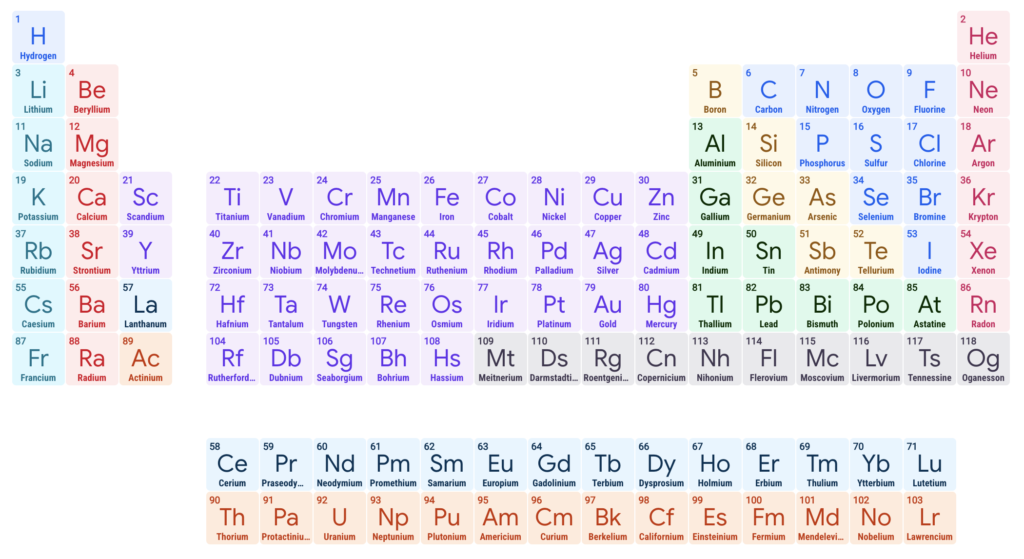
As the name suggests, binary ionic compounds consist of two elements that are ionically bonded, a metal and a nonmetal. On the periodic table, metals are located in the left and middle groups, while nonmetals are on the right.
Note: In some cases, it is unclear whether or not two elements would form an ionic or covalent compound; a comparison of the electronegativities of each would be necessary to determine this.
Formula to Name
In naming a binary ionic compound, the cation (metal) is written first, followed by the name of the anion (nonmetal). A helpful mnemonic is to visualize the “t” in “cation” as a “+” to remember that cations are positive due to loss of electrons.
Monatomic cations retain the element name. For example, Ca²⁺ is the calcium ion and Na⁺ is the sodium ion. To name the anion, drop the element ending and replace it with “ide” Cl⁻ is the chloride ion, and Se²⁻ is the selenide ion. In compound names, the word “ion” is omitted.
Naming is straightforward from here. NaCl is “sodium chloride.” BeSe is “beryllium selenide.” CaF₂ is “calcium fluoride.”
🧪 Try these yourself! Click the dropdown for the answer.
CaO
calcium oxide
Fun fact: calcium oxide is colloquially known as quicklime, a reactive solid that is produced by heating limestone (calcium carbonate, CaCO3). It is named such because it reacts energetically with water to produce slaked lime (calcium hydroxide).
CaCl₂
calcium chloride
Fun fact: Calcium chloride tastes extremely salty but contains no sodium, and is used in some low-sodium snacks.
NaF
sodium fluoride
Fun fact: When dentists apply fluoride to your teeth during an appointment, they commonly give it in the form of sodium fluoride.
Name to Formula
Whereas one could ignore subscripts when writing names, deriving formulas from names requires an extra step to deduce the subscripts using the cross-and-drop method.
When writing the formula for magnesium iodide, the first step is to write element symbols and corresponding charges based on position in the periodic table (Mg²⁺ and I⁻). After crossing and dropping the charges, the final result would be MgI₂. The ratio of the elements must lead to the overall compound being electrically neutral. Sometimes, simplification of the ratio is necessary, such as in aluminum nitride (AlN), since ionic compounds exist in crystal lattices rather than molecules.
🧪 Try these yourself! Click the dropdown for the answer.
zinc sulfide
ZnS
Fun fact: zinc sulfide was originally used to make glow-in-the-dark stickers, since it becomes phosphorescent when mixed with trace amounts of activator.
magnesium iodide
MgI₂
Fun fact: scientists create MgI₂ in the lab, and have to store it in dark air-tight containers to prevent exposure to air or light, both of which would cause its weak chemical bonds to break.
lithium phosphide
Li₃P
Fun fact: Pure lithium is the lightest metal in the universe.
Binary Ionic With Transition Metals
Transition metals differ from alkali and alkali earth metals (columns 1 and 2) in that their charges cannot be immediately deduced from their position in the periodic table. Transition metals take on varying charges; for example, Fe commonly adopts a charge of 2+ or 3+ in an ionic compound.
To eliminate ambiguity, the charge of the cation is specified in roman numerals as part of the cation name. Examples include iron (II) oxide and lead (IV) chloride. Thus, iron (II) oxide and iron (III) oxide are two distinct compounds.
Name to Formula
This process is identical to the one for binary ionic with metals in groups 1 and 2. Instead of consulting the periodic table for the charge of the cation, one would simply consider the one provided. Iron (II) oxide is FeO, and lead (IV) chloride is PbCl₄.
🧪 Try these yourself! Click the dropdown for the answer.
iron (II) oxide
FeO
lead (IV) chloride
PbCl₄
copper (II) phosphide
Cu₃P₂
Formula to Name
We must use a reverse cross-and-drop process to find the charge of the cation for insertion into the name. Using the subscripts of both elements and the charge of the anion, one can find the charge of the cation. For example, looking at Fe₂O₃ and acknowledging that oxygen has a 2- charge, Fe is determined to be the iron (III) ion. Thus, Fe₂O₃ is iron (III) oxide. When ratios of charges are reduced in the subscripts, ensure to multiply accordingly. For example, PbS is lead (II) sulfide.
Several common metals almost exclusively form a single charge, and are therefore named as regular binary ionic compounds, without specification of charge. These are the following: Ag¹⁺ (silver ion), Zn²⁺ (zinc ion), Cd²⁺ (cadmium ion), Al³⁺ (aluminum ion), and Sc³⁺ (scandium ion). More include the following, though they are less common: Ga³⁺ (gallium ion) and In³⁺ (indium ion).
🧪 Try these yourself! Click the dropdown for the answer.
CoBr₃
cobalt (III) bromide
ZnO
zinc oxide
Charge specification is not necessary since zinc almost exclusively forms a 2+ charge.
PbS
lead (II) sulfide
Common Charges of Transition Metals
Neither going from name to formula nor from formula to name will require a memorization of the common charges of transition metals. However, it can be helpful to understand chemistry better as a whole.
Cr²⁺ / Cr³⁺ / Cr⁶⁺ – chromium (II) ion / chromium (III) ion / chromium (VI) ion
Fe²⁺ / Fe³⁺ – iron (II) ion / iron (III) ion
Co²⁺ / Co³⁺ – cobalt (II) ion / cobalt (III) ion
Ni²⁺ / Ni³⁺ – nickel (II) ion / nickel (III) ion
Cu¹⁺ / Cu²⁺ – copper (I) ion / copper (II) ion
Sn²⁺ / Sn⁴⁺ – tin (II) ion / tin (IV) ion
Pb²⁺ / Pb⁴⁺ – lead (II) ion / lead (IV) ion
Hg₂²⁺ / Hg²⁺ – mercury (I) ion / mercury (II) ion
Polyatomic Ions
Binary ionic compounds consist of only two elements, one cation and one anion. However, in many ionic compounds, the cation and/or anion are polyatomic ions. Below is a list of common polyatomic ions and their names.
NH₄⁺ – ammonium
OH– – hydroxide
O₂²⁻ – peroxide
CN– – cyanide
C₂H₃O₂– – acetate
SCN– – thiocyanate
Cr₂O₇²⁻ – dichromate
C₂O₄²⁻ – oxalate
Deriving name from formula and formula from name follow the same rules as for binary ionic compounds. Lithium hydroxide is LiOH. Parentheses are necessary to contain the polyatomic ion when its subscript is more than 1. For example, lead (IV) oxalate is Pb(C₂O₄)₂. This ensures that the subscript is attributed to the entire polyatomic ion rather than only the last element.
🧪 Try these yourself! Click the dropdown for the answer.
hydrogen hydroxide
HOH or H₂O
This compound is almost exclusively referred to as water rather than hydrogen hydroxide. It is sometimes written as HOH rather than H₂O in acid-base reactions to emphasize that water is both an acid and a base.
KCN
potassium cyanide
magnesium acetate
Mg(C₂H₃O₂)₂
Oxyanions
Oxyanions follow the formula XOₙᵐ⁻, where m is a positive integer and X is commonly, but not always, a nonmetal. They consist of one or more oxygen atoms bonded to the nonmetal, and are highly stable despite their negative charge, thus serving as essential molecules in biochemistry and materials science.
Naming oxyanions requires the use / memorization of the following chart.
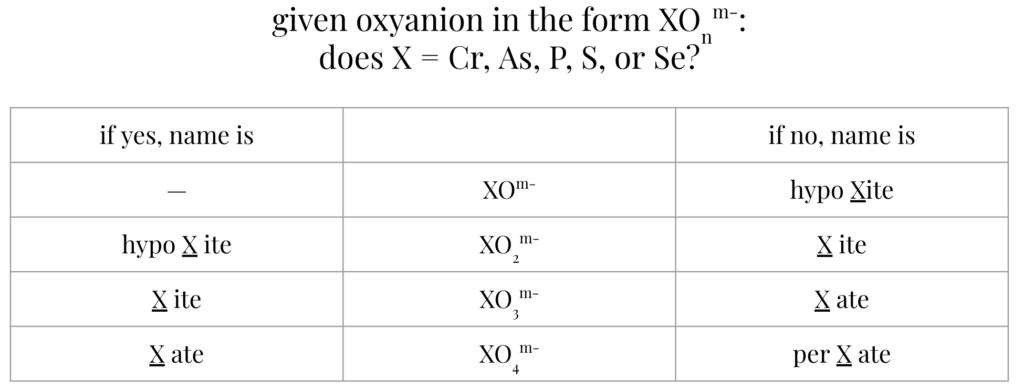
Usage of the chart is relatively straightforward. The middle column specifies the number of oxygen atoms, and the left and right columns contain the corresponding names based on the identity of X, since if X is any of the elements specified, an oxyanion with a singular oxygen atom would be extremely unstable. Note that the names on the left are a shifted-down version of the right column. This chart is essential in not only naming oxyanions, but distinguishing between compounds like nitrite and nitrate and phosphite and phosphate, a frequent source of confusion.
🧪 Try these yourself! Click the dropdown for the answer.
SO₄²⁻
sulfate ion
ClO₄⁻
perchlorate ion
hypofluorite ion
FO⁻
arsenite ion
AsO₃³⁻
Acids
By the Brønsted-Lowry definition, an acid is a compound that can donate H+ to the solution. Thus, all acids contain one or more hydrogen ions, and since these are cations, they are written at the beginning of the acid formula. This also serves as a visual cue for identification. This is why acidic solutions have a lower pH (pH stands for potential/power of hydrogen, measured by taking the negative of the common log of the H concentration).
Acid molecules are electrically neutral, and they are formed by taking an anion and adding H+ until the negative charge is cancelled out. For example, the acid with Cl- as its anion is HCl, and the acid with PO₄³⁻ as its anion is H₃PO₄.
Acids are based on the ending of their anions. The naming chart for acids simply matches an ending to an acid name, and can be memorized through mnemonics.
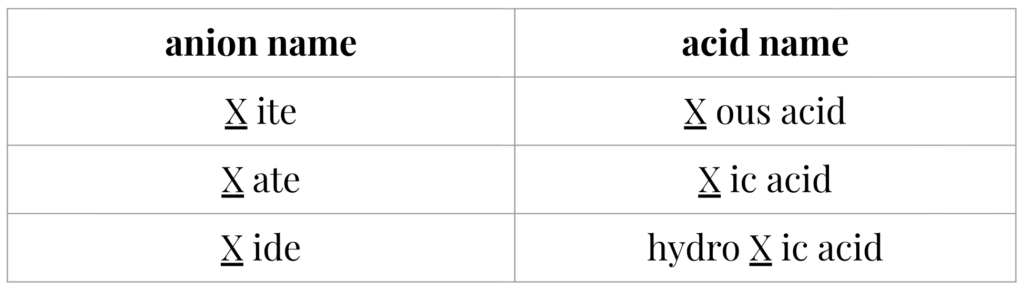
A helpful way to internalize these naming rules is to think of words that contain the anion ending and name, for example using “tendonitis” and “Natick” to remember “ite – ous” and “ate – ic.”
🧪 Try these yourself! Click the dropdown for the answer.
HF
hydrofluoric acid
HClO
hypochloric acid
bromic acid
HBrO₃
phosphorous acid
H₃PO₃
When discussed in the context of organic chemistry, some acids are not written with the H in front. For example, in organic chemistry, acetic acid is written as CH₃COOH rather than HC₂H₃O₂, for the sake of emphasizing the COOH functional group. Additionally, some compounds have multiple names from different naming methods. For example, acetic acid, named using foundational naming rules from the acetate ion, is also known as ethanoic acid, its systematic organic name.
Binary Molecular
Binary molecular compounds consist of exactly what their name suggests: two covalently bonded elements. They follow the formula AₓBᵧ, where A and B are nonmetals. (In intro chem, if one were a metal, the compound would be ionic, and if both were metals, the compound would be a metal alloy; both cases do not result in molecular compounds).
Naming binary molecule compounds is relatively straightforward. CS₂ is carbon disulfide, and N₂O₄ is dinitrogen tetroxide. Only a consideration of the elements’ subscripts is necessary. Here are the prefixes for numbers up to twelve: mono (for y), di, tri, tetra, penta, hexa, hepta, octa, nona, deca, undeca, and dodeca. If x is 1, A forgoes the prefix. Hence CO is named carbon monoxide, not monocarbon monoxide.
Whereas in binary ionic compounds the element written first was the cation, in binary molecular compounds the element written first is the one with lower electronegativity. This is typically the one farthest from F on the periodic table.
Additionally, extra vowels are dropped when they are redundant in the pronunciation. Br₂O₇ is bromine heptoxide, not “bromine heptaoxide.” On the other hand, if both vowels are pronounced, a double vowel may remain in the spelling. For example, BrI₃ is bromine triiodide. The “i” sound is said twice.
🧪 Try these yourself! Click the dropdown for the answer.
Br₂O₇
dibromine heptoxide
SCl₆
hypochloric acid
Linear Alkanes
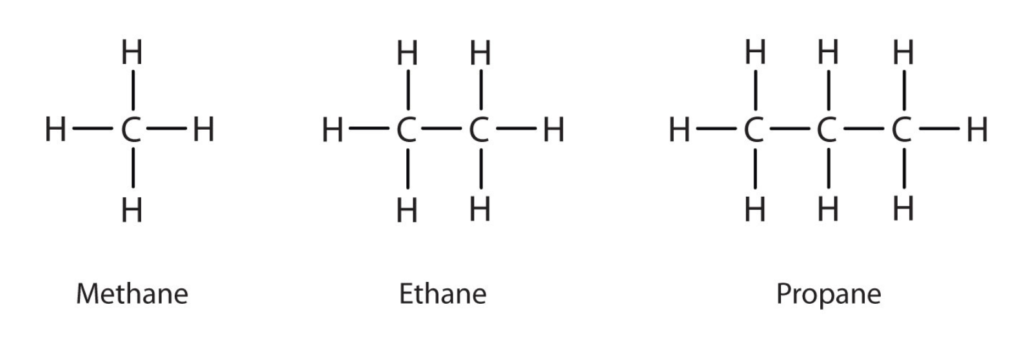
Linear alkanes follow the formula CₙH₂ₙ₊₂. As hydrocarbons with only single bonds, alkanes are commonly used as energy sources. Their nonpolarity also makes for good solvents for nonpolar solutes. It is easy to visualize their formula: each carbon in the alkane has two hydrogens on either side, and the overall compound has an additional two hydrogens to make the outer boundary complete.
Alkanes are named through prefixes based on the subscript of carbon. The prefixes from one to ten are as follows: meth, eth, prop, but, pent, hex, hept, oct, non, and dec. For example, CH₄ is methane, and C₉H₂₀ is nonane.
🧪 Try these yourself! Click the dropdown for the answer.
hexane
C₆H₁₄
the alkane with 22 hydrogen atoms
decane
C₅H₁₂
pentane
End of resource content. Check introductory blurb for practice resources.
✸ Thank you for reading!
Feel free to submit feedback (questions, suggestions, or areas to point out about this guide) through this form!
This resource was published on The Sparchive on June 7, 2026.