SAT Question Type Handbook
The SAT is like a game. It tests you on how well you can play it more than how well you understand English. Drilling question types is an optimal way to develop a testing strategy tailored to each question type, making the exam more predictable. This resource provides tips to master each question type and answer them with higher efficiency and accuracy.
Introduction
The R&W section of the SAT consists of 2 modules. With 32 minutes for 27 questions, each module allots slightly over 1 minute per question. Submitting module 1 with approximately 7-8 questions (depending on the exam) wrong or unanswered will lead to the easier module 2, and otherwise the harder module 2. The exam breakdown into 4 domains is as follows:
Craft and Structure – 28% (Reading)
Information and Ideas – 26% (Reading)
Expression of Ideas – 20% (Writing)
Standard English Conventions – 26% (Writing)
Each domain is a tab in this resource, with its 2-4 question types. Under each question type are two example questions (as well as their ID on the SAT Suite Question Bank for further reference) and the recommended strategies. Skip to the domain and question type you need help with, or read this document through for a complete guide*. Scattered throughout are general tips that apply to multiple question types.
*As mentioned in my SAT Crash Courses, the best way to use this document would be to reference its tips while drilling that particular question type (between first and second drilling sitting). Disclaimer: These studying strategies scored me a 1550, but are by no means a necessary guideline or a universal method.
Craft and Structure consists of 3 question types: words in context, text structure and purpose, and cross-text connections.
✸ Words in Context (vocabulary)
example question 1 (ID: e35d481c)
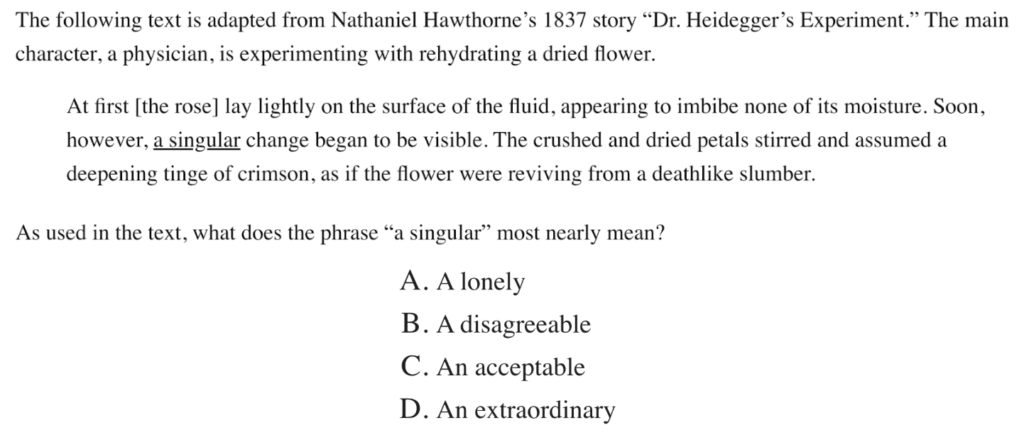
example question 2 (ID: 359902ae)
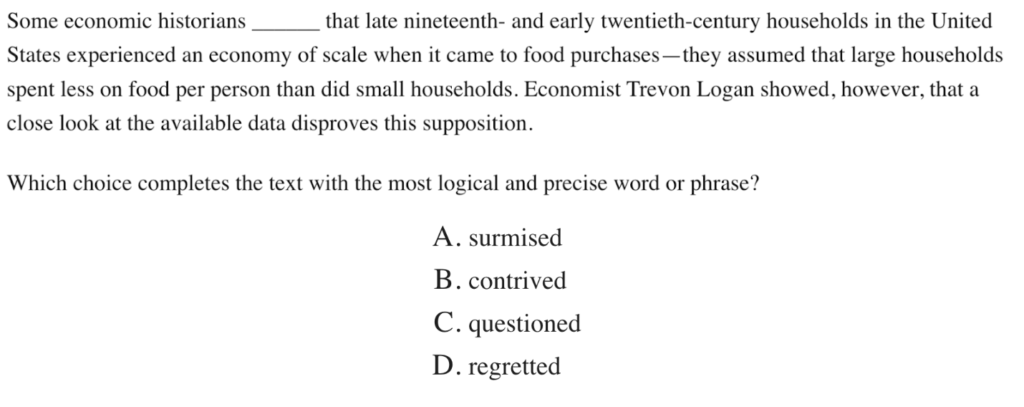
If you read frequently, you probably don’t need to do much studying for this question type. Nonetheless, vocabulary is the worst part of the SAT to study for last minute because it is cumulative. Here are ways to prepare:
- search up SAT vocab lists (vocab that tend to show up often on the exam)
- make your own flashcards from these lists
- write sentences with the words as you learn each one
- list example: https://img.sparknotes.com/content/testprep/pdf/sat.vocab.pdf
- drill vocabulary questions from the SAT Suite Question Bank; afterwards, search up unfamiliar words from the answer choices
- make flashcards / lists from the words you got wrong
- buy physical flash card box sets from Amazon / other site
- (habit) read: books, news articles, papers, etc.
While you cannot study every single word in the dictionary, studying words that commonly show up on the test will increase your odds of recognizing the word choices on any given question.
If you are stuck on the problem:
- break down words by prefixes and suffixes to guess their meaning
- eg. circumspect: circum → around; spect → look; circumspect → careful and wary, considering many cases
- very helpful for increasing “word sense”
- if stuck after eliminating, simply take a guess and move on
For synonym questions, such as example question 2:
- will typically give you a word or phrase with many meanings
- test you on the skill of inferring definitions from context, so the answer choice that is the most obvious* one is almost never the answer
- *obvious meaning the answer choice that you’d likely select if you hadn’t read the passage
- eg. in example question 2, answer would not be lonely, which you could infer without reading the passage (otherwise the question wouldn’t be testing words in context)
- substitute answer choices in the blank of the sentence and see it makes sense
- while reading, note the idea of the sentence and connotation of the word
 GENERAL TIP:
When a question gives you context, don’t read the whole context. Skim it for the 2 key details to know: the type of literary work, and the introductory blurb to what’s happening in the text. For instance, upon seeing the context in example question 2, you would note “story” and “main character, a physician, is experimenting with rehydrating a dried flower.” The introductory blurb makes reading the actual text more efficient, so you know what to expect in the passage. Everything else is excess to slow you down (technically for citation purposes).
✸ Text Structure and Purpose (exactly what the name implies)
example question 1 (ID: 2af2016f)
example question 2 (ID: e818241b)
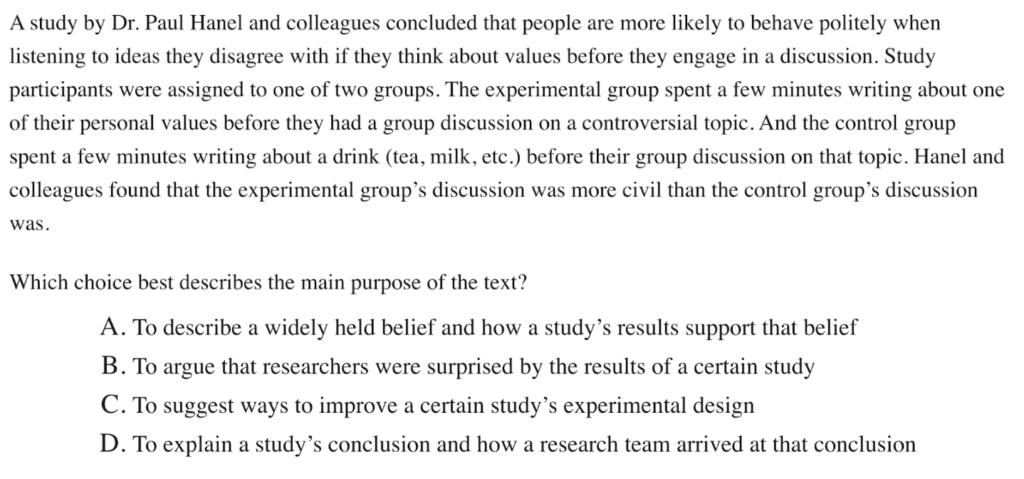
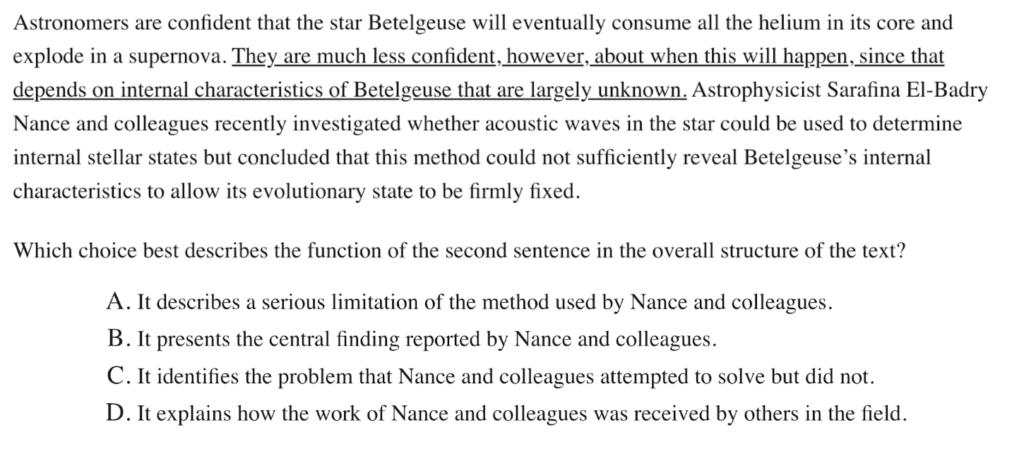
Text structure and purpose questions will either ask you for the main purpose of the text, or the function of an underlined text.
For main idea questions:
- stay attentive to main themes while you are reading, so that you can select an answer choice without having to reread the passage
- a common type of wrong answer picks out a single detail from the text; it is accurate, but it is not the main idea
- follow the logic flow of the text and think about the ideas its sentences build towards
Once you see underlined text, you know you’re being asked its function.
- while reading, note the relationship between the underlined text and the rest of the passage
- could be: an example, a refutation, evidence to back a study, an explanation of a previously stated phenomenon, emphasize a characteristic of a person, etc.
- make sure the selected answer choice stays within the context of the text; be wary of extreme claims
✸ Cross-Text Connections (double passages)
example question 1 (ID: c4737d6a)
example question 2 (ID: 8d802289)
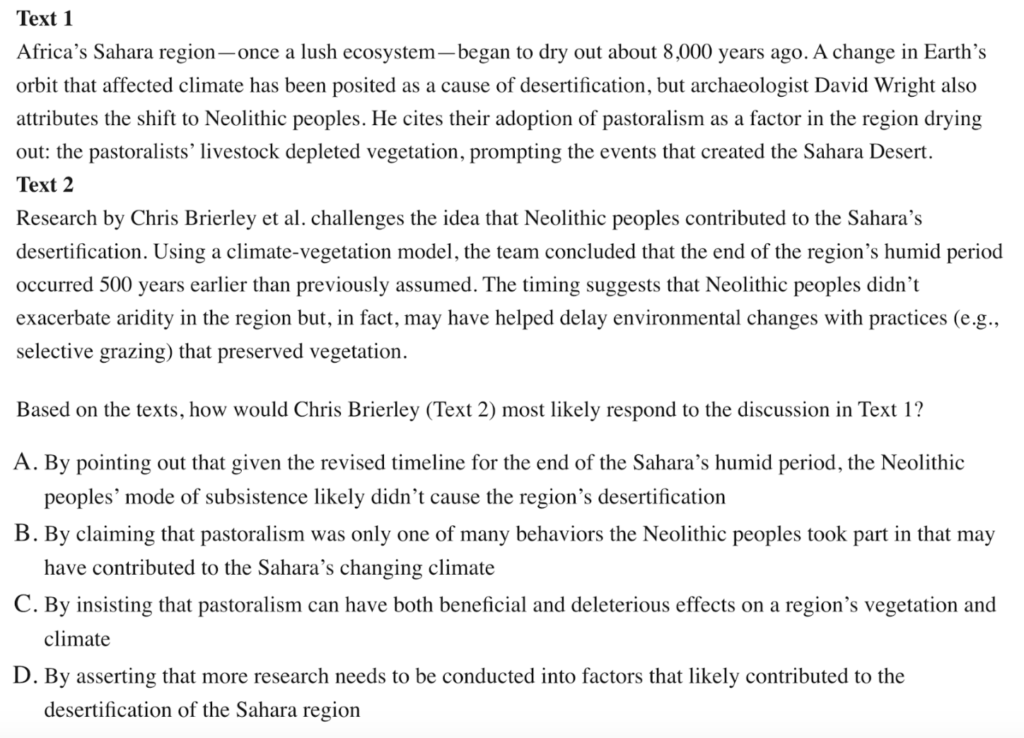
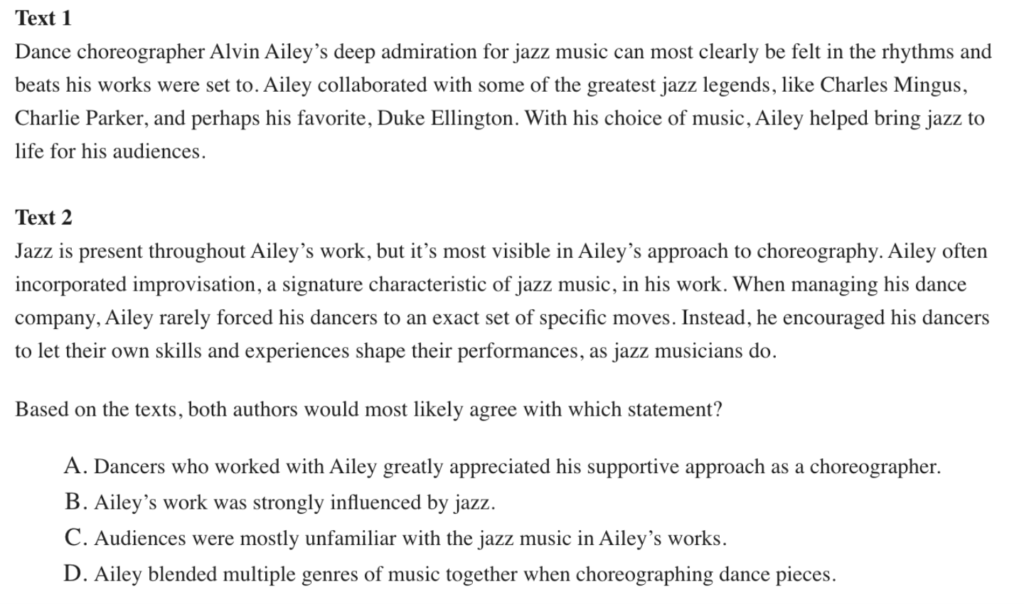
Read both texts attentively, focusing on their stance on a certain topic. Keep the stance of the first passage in mind while you read the second. When done with both texts, you should have acknowledged their relationship to each other, whether that be disagreement, agreement, or variance in nuance on an idea.
When eliminating answer choices:
- be wary of extreme answer choices
- passages should provide concrete evidence to support the answer choice
- don’t think about implications beyond what the author of each text is explicitly saying
Information and Ideas consists of 4 question types: inferences, central ideas and details, command of evidence (textual), and command of evidence (quantitative).
✸ Inferences (infer, don’t guess)
example question 1 (ID: ca5a3fb4)
example question 2 (ID: 6b8a7c74)
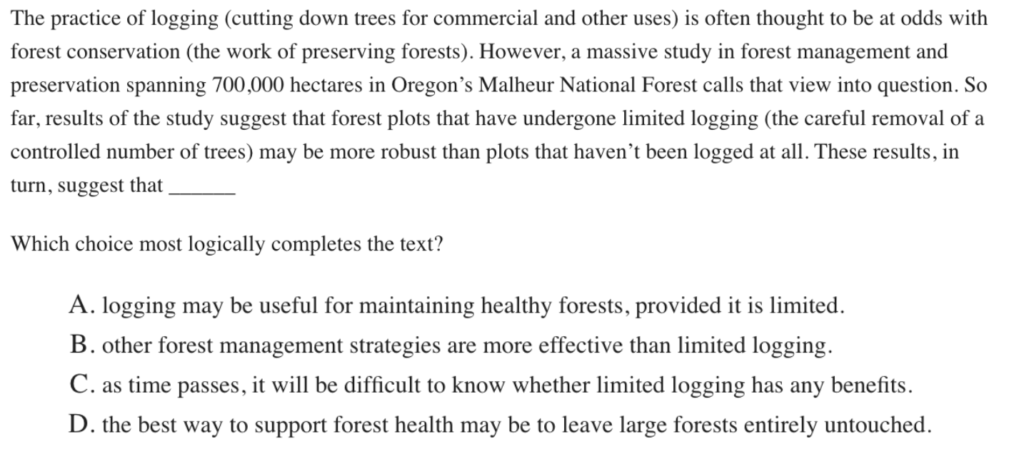
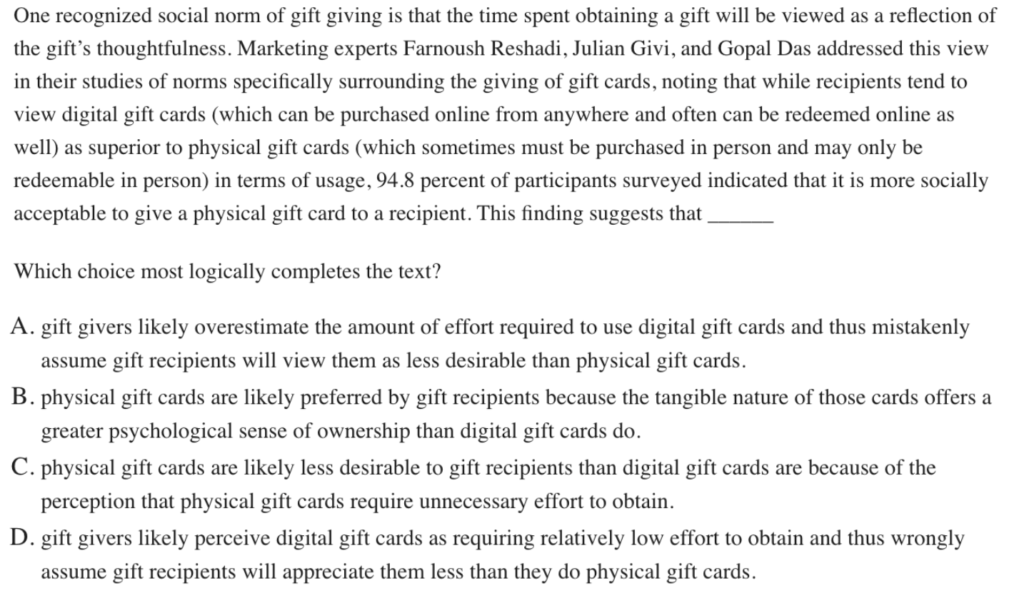
When you see a blank at the end of the text, your brain should immediately turn on the logical reasoning strategy for this question. The passage will likely be about a study or sociological pattern. Pay attention to the details and evidence being used, and follow its path of reasoning so that when you get to the blank, you think of an inference before looking at the answers. Reading all the answer choices before coming to a conclusion usually interferes with your reasoning and may bias you into selecting certain answer choices. Inference questions usually have a conclusion that can be easily predictable after the phrasing of evidence. With practice, you’ll see that the correct answer choice comes increasingly expected after digesting the text.
GENERAL TIP:
Avoid answer choices that make extreme claims, straying beyond the appropriate context of the problem. These will often include words such as “always,” “never,” “best,” or “worst.” This applies to multiple question types!
✸ Central Ideas and Details (old-school classroom questions)
example question 1 (ID: 92c2564d)
example question 2 (ID: cf956802)
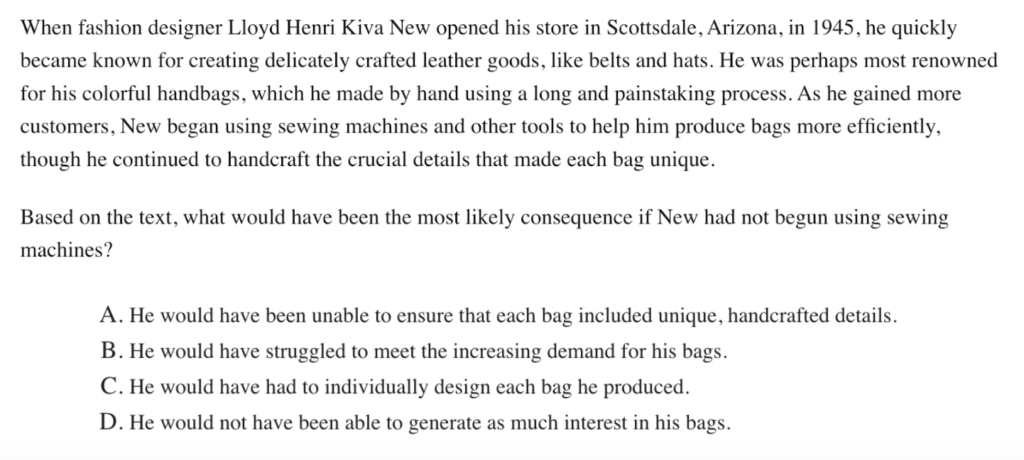
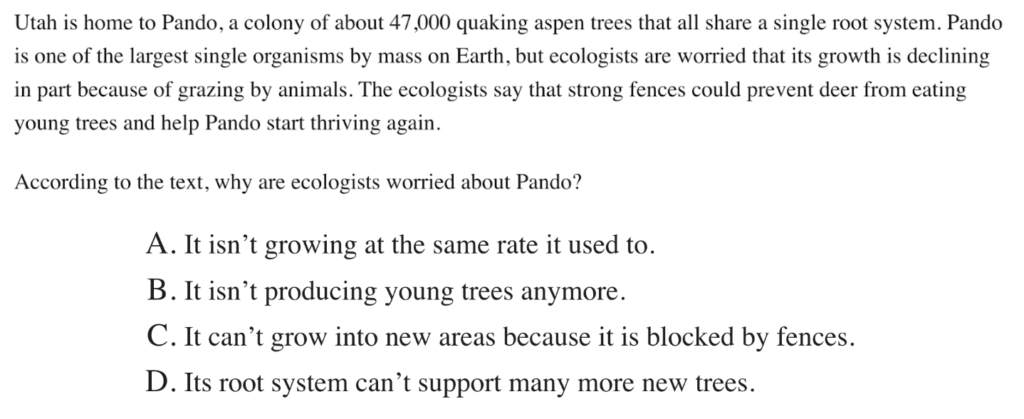
These are old-school classroom questions in the sense that they’re what an average English teacher would put on their test for students’ reading comprehension. Questions will ask you specifically about the text, or its main idea.
For such questions, read the question first, so you know what you’re looking for. Then go back to the passage and stay attentive for the information needed. This works well because for central ideas and details questions, there will always be a specific line that directly supports the correct answer choice. If you can’t find that in the text, the answer choice is wrong. Again, eliminate all extreme and far-fetched answer choices.
Reading the question first for these types of questions will make you save time and avoid reading the text twice.
✸ Command of Evidence (Textual) (supporting evidence)
example question 1 (ID: 29f5c8c2)
example question 2 (ID: 98d0a5d7)
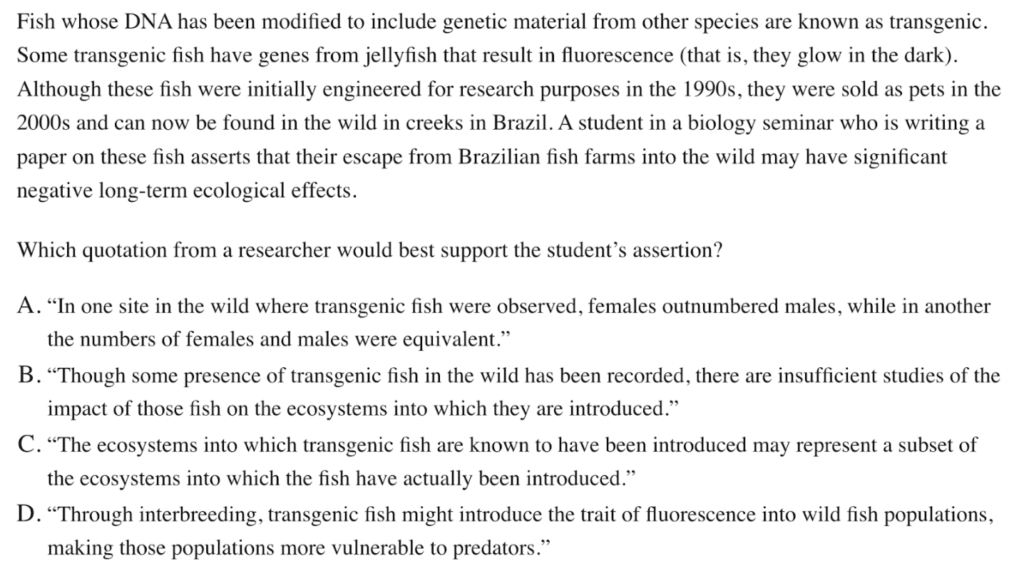
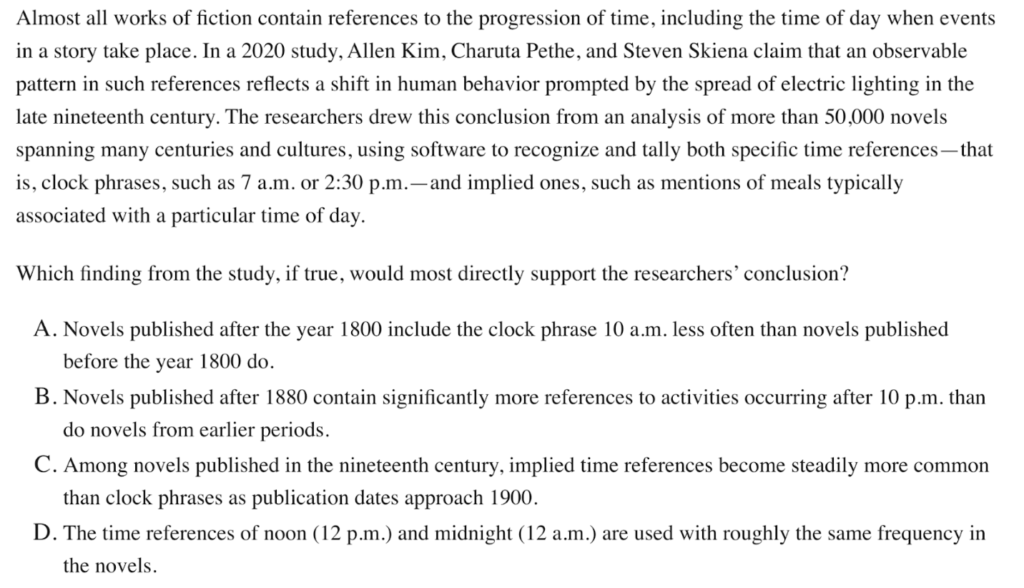
In command of textual evidence questions, you will not be able to find explicit evidence from the text to support the answer choices. While you read, pay close attention to the stance of the passage. Keep the text’s claim in mind while you purge incorrect answer choices. Unlike inference questions, you do not need to come up with an answer before examining the answer choices, because it would be a waste of time to try predicting such niche evidence; you just need to know the stance of the passage.
You will be asked for a piece of evidence that either supports or undermines the claim presented. Ask yourself: If this piece of evidence were added to the text, would it support/undermine the claim, or would it simply provide irrelevant information or make an extreme statement? For the harder questions of this type, all answer choices may seem to stray a little outside the context of the problem, but there is always only one choice that best accomplishes the goal.
GENERAL TIP:
Should I check my work? Yes, but not by going through every problem at the end of the section. Instead, take 5 seconds at the end of each problem only to check for misclicks and if you read the question correctly. (For command of textual evidence questions, check again if you were asked to support or refute the claim.) Don’t waste time re-solving the problem; you should have solved carefully the first time. If you do feel you need to re-solve, bookmark the question and return to it later. These 5 seconds are to check mistakes with 2-second fixes before moving on.
✸ Command of Evidence (Quantitative) (tables and graphs)
example question 1 (ID: 1281dfd5) – harder
example question 1 (ID: 75e07a4d) – easier
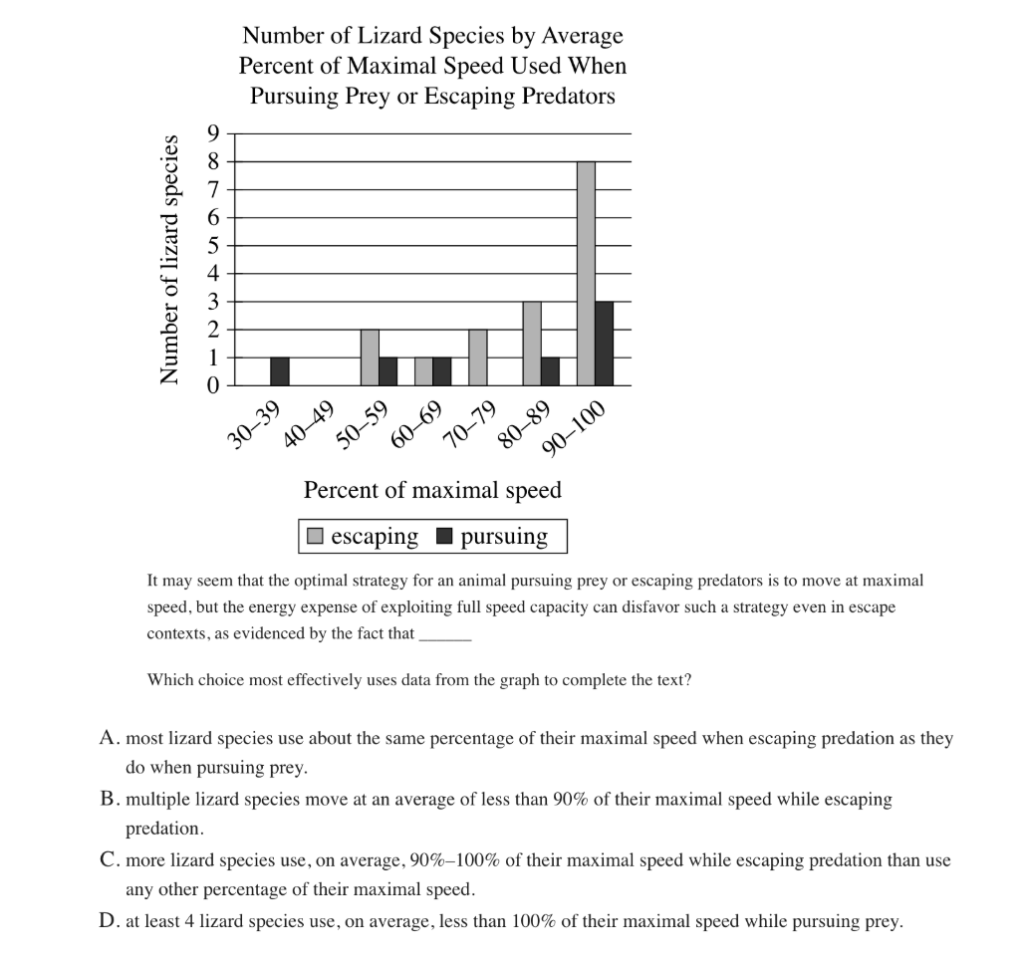
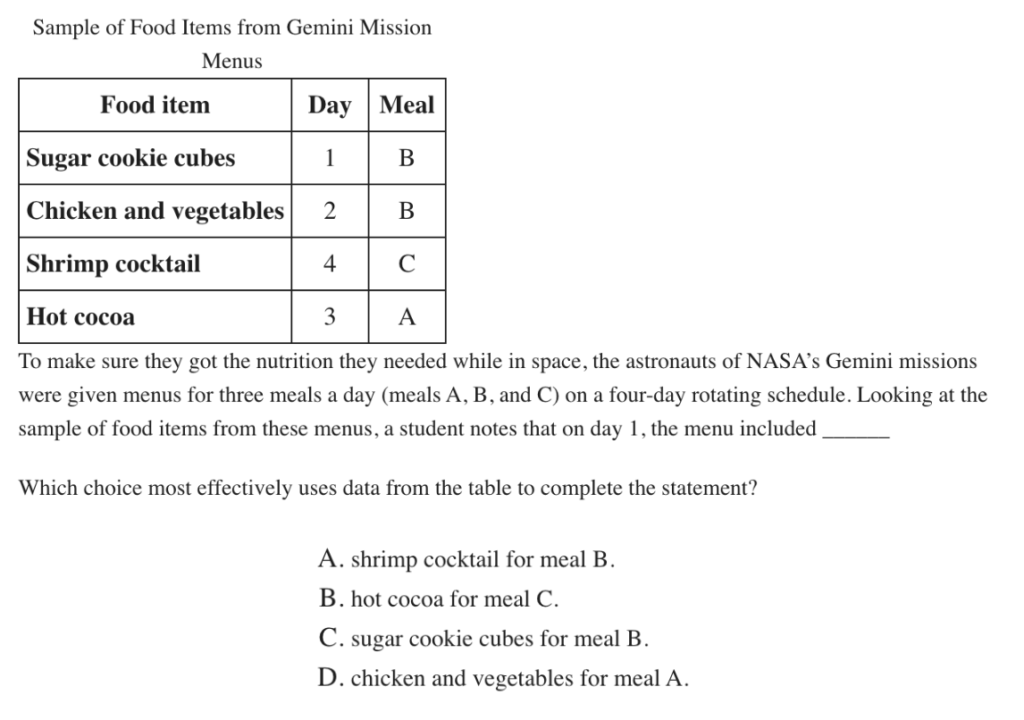
These questions present you with a graph or table, and will ultimately ask you for evidence from the figure to complete the last sentence of the text.
Start the question off by looking at the figure to get a feel for what the study is examining; it gives you an idea of what the passage will talk about. Read its title, identify what the data shows, and notice trends, if applicable. By familiarizing yourself with the figure, you’ll make the problem much faster to do, since the study sometimes may sound confusing and hard to read without context.
Example observations while doing example question 1: Number of lizard species by percent of max speed used while pursuing prey or escaping predators. The axes are number of lizard species and percent of maximal speed, and two colors are used for escaping and pursuing. There is a noticeable difference in distribution between escaping and pursuing. Perhaps their strategy for using speed differs based on the situation. Subsequently, reading the text reveals that the question indeed asks for information regarding escaping rather than pursuing. The answer choice that best shows that using max speed while escaping is not optimal turns out to be answer choice B.
If the question is easier (early parts of module 1, or the figure looks very simple) it is often feasible to simply read the question (last sentence of the passage) and immediately find the correct answer in the figure and move on. This will save you large amounts of time.
The correct answer:
- uses correct data from the figure
- eliminate all answers that use incorrect data or misinterpret the figure
- effectively uses it to complete the statement
- ensure your answer aligns with the stance you observed in the text
Expression of Ideas consists of 2 question types: transitions and rhetorical synthesis.
✸ Transitions (logic)
example question 1 (ID: 2b08f514)
example question 2 (ID: 660d50dc)
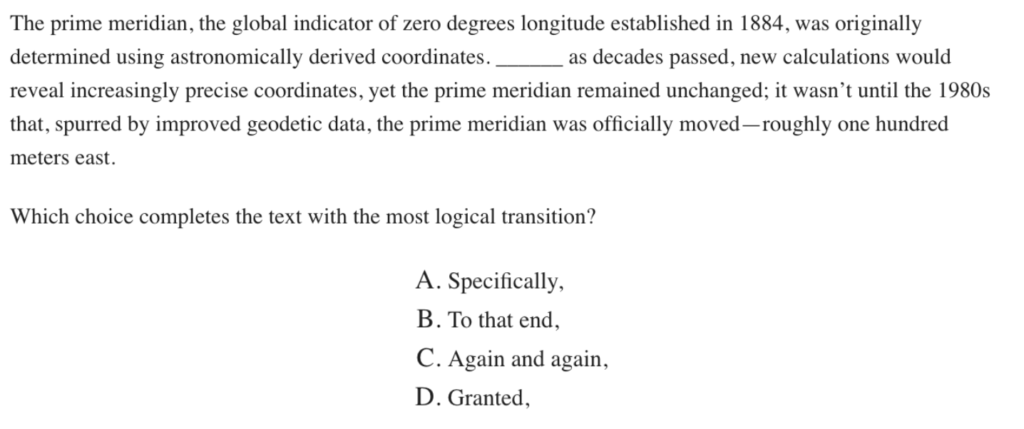
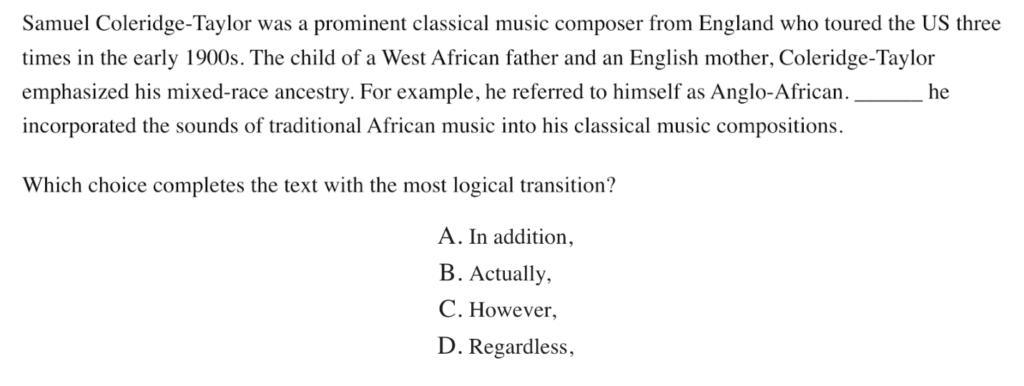
These questions are characterized by blanks in the middle of text;
- be attentive to the logic and flow of the question so that when you get to the blank, it’s intuitive which transition word you should use
- think about the purpose of the last sentence (with the blank) and how it connects to the rest of the sentence
A chart of common transitions you should know:
then,
lastly,
for example / for instance,
in sum / in summary,
in addition / additionally,
thus,
instead,
similarly,
likewise,
however,
nonetheless,
ultimately,
in other words,
by contrast,
actually,
conversely,
furthermore,
alternatively,
granted,
specifically,
regardless,
moreover,
on the other hand,
meanwhile,
Don’t lose points by not knowing these!
in turn,
accordingly,
what’s more,
that being said,
consequently,
to that end,
hence,
admittedly,
again and again,
of course,
granted,
that is,
Note on common mistake: Know the difference between “specifically” and “for example.”
✸ Rhetorical Synthesis (student’s note-taking)
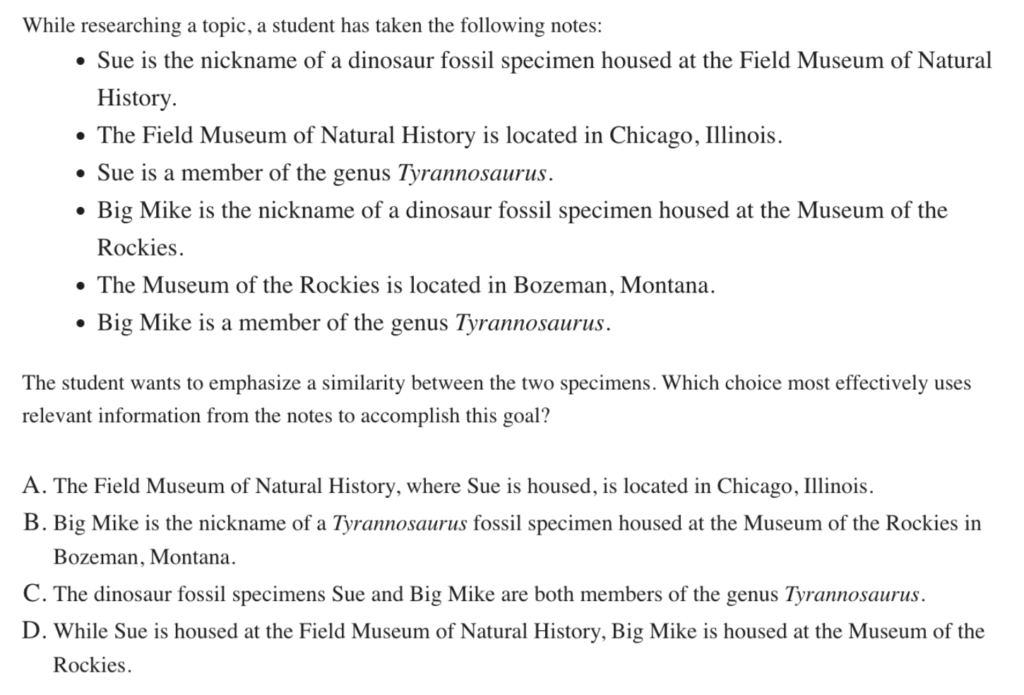
example question 1 (ID: af76771f)
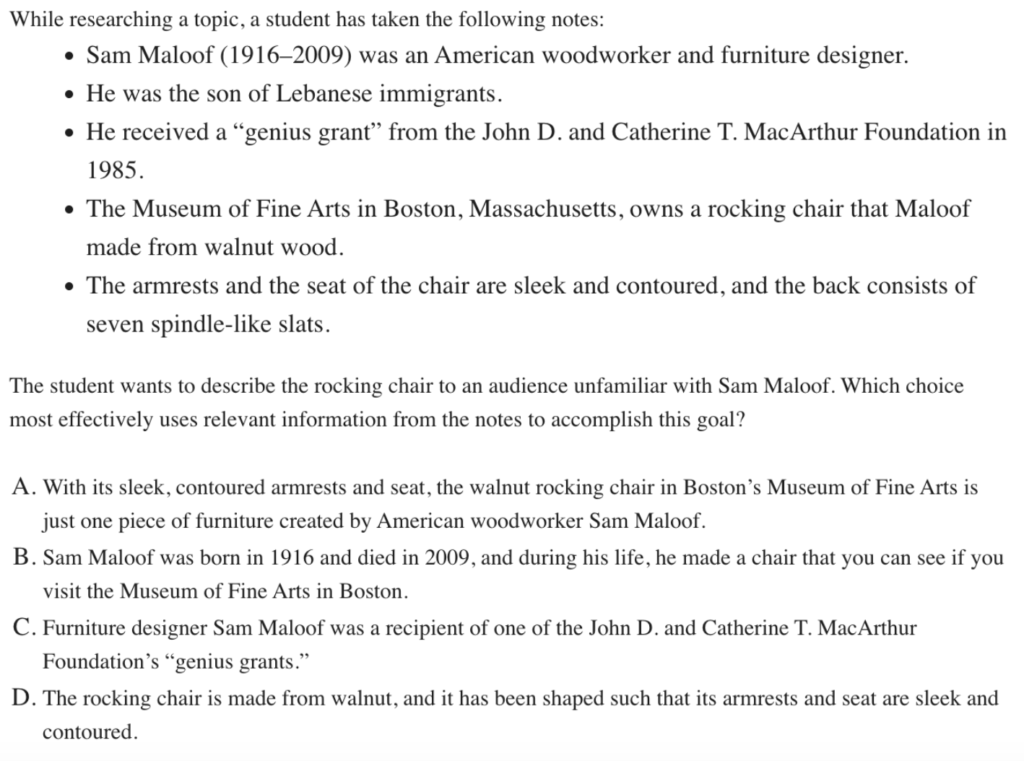
example question 2 (ID: 48d0bb34)
The most efficient way to do this question type is to skip the notes.
Directly read the intent of the student; this could be emphasising a similarity or difference, presenting a study or concept, or identifying a number of objects or location of an event. The answer choices could all contain correct information from the notes, but often there will only be one choice that accomplishes the goal of the student.
For easier questions in module 1, the answer choice is almost always immediately clear. In example question 1, you are asked to emphasize a similarity between two specimens. Choices A and B are mere statements that do not accomplish this goal. Choice C is the only one that gives a similarity. Choice D does the opposite and highlights a difference; your brain might red flag the word “while.”
For harder questions that ask you to describe a style or introduce a study, there is a specific phrasing desired that best accomplishes the goal. If it’s not immediately obvious to you, it will be with more practice. (Filter hard rhetorical synthesis questions on the SAT suite.)
For harder questions at the end of the second module, you might be asked to present a historical overview of an event or a generalization of an idea. Since the answer might not be as obvious as other rhetorical synthesis questions, you would keep the goal of the question in mind and go back to skim the notes before answering.
Even though a couple questions may require going back to skim the notes, always read the question and eliminate first. Either you’ll be able to save time and move on, or you’ll go back and know exactly what to look for.
Standard English Conventions consists of 2 question types: boundaries and form, structure, and sense.
*note: this resource’s content for Standard English Conventions is less comprehensive; for more practice, visit the grammar section of the SAT Suite Educator Question Bank, or see all tested rules from college-panda
✸ Boundaries (punctuation)
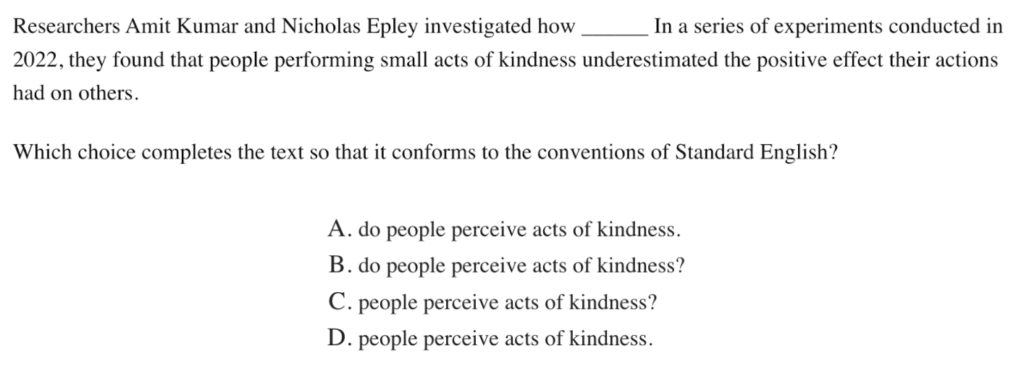
example question 1 (ID: a7c85001)
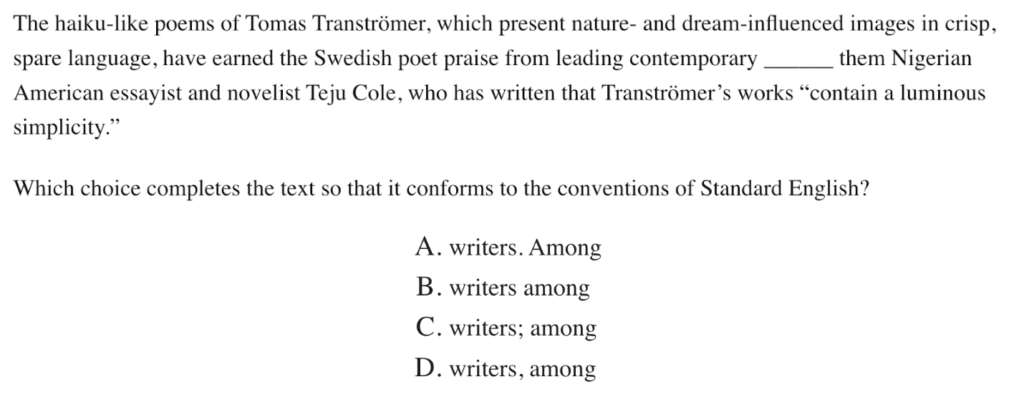
example question 2 (ID: adf210e7)
General concepts:
- periods, commas, semicolons, and colons
- identifying comma splices, run-ons, and fragments
- difference between independent and dependent clauses
GENERAL TIP:
If two answer choices are nearly identical, eliminate both of them, since they can’t both be right. For example, if you see two grammar choices where one uses a semicolon and the other a period, you can eliminate both of them, since they serve the same purpose in a sentence.
Supplementary elements: extra information in a sentence can be bordered off from the rest of the sentence using parenthesis (), commas (,) or em dashes (—). Be consistent; what starts the extra information must also end it.
- eg. “When exposed to low levels of light, the plant’s chloroplasts—the cellular organs that generate energy from light—reshuffled to form a tightly packed, glass-like surface ideal for collecting more light.”
- eg. “Photosynthesis, the mechanism by which plants use sunlight to turn carbon dioxide and water into nutrients, is fueled in part by an enzyme called Photosystem II.”
How can you tell whether a phrase is a supplementary element or not? If it is, you should be able to remove it from the sentence and still have it make sense. (See examples above.)
Here is a common instance of when you should not use a comma because the phrase is actually necessary to complete the sentence: “Fans of the film Moana (2016) may not know that the deep and humorous voice behind the character Tamatoa the crab belongs to comedian, actor, and musician Jemaine Clement.”
Explanation: “Tamatoa the crab” is needed in the sentence since “the character” requires specification. If “the” before “character” was changed to “a,” you would not need the phrase “Tamatoa the crab,” and it would qualify as extra information; then, you would use a comma to bar it off.
✸ Form, Structure, and Sense (other grammar)
example question 1 (ID: 908a76b8)
example question 2 (ID: 37e5c794)
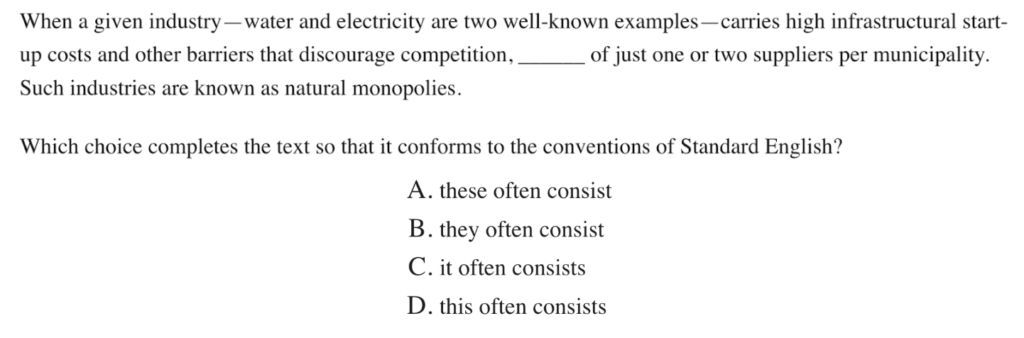
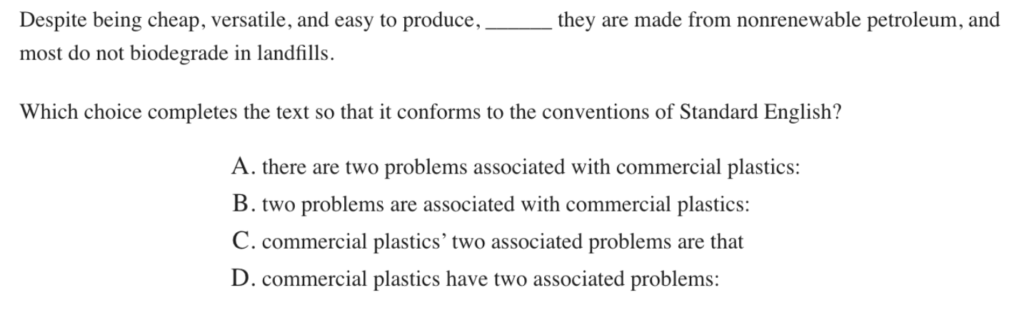
General concepts:
- apostrophes
- plurals
- pronoun agreement and clarity
- parallel structure
- modifier placement
The answer choices themselves are your guide to what grammatical concept is being tested. If the choices show different verb tenses, focus on the timeframe of the sentence. If they are different pronouns, keep an eye out for which noun might be replaced as the subject. If punctuation varies, pay attention to the structure of the parts of the sentence that flank the blank.
For pronoun questions, trace the noun carefully! It may occur in a much earlier part of the sentence, like “industry” in example problem 1.
Example problem 2 tests you on subject-modifier placement. Each answer choice says the same thing, but is ordered differently. The first word of the phrase must be the target of the descriptive phrase that came before. For example, “commercial plastics” must go right after the blank, since they are targeted by the description “being cheap, versatile, and easy to produce.” This is to ensure clarity for the reader.
Know when to use commas vs. semicolons in lists:
- “Using natural debris, such as dried leaves; man-made trash, such as plastic bags; and more traditional art supplies, such as tree glue, Ghanaian artist Ed Franklin Gavua creates his striking Yiiiiikakaii African masks, which he hopes can help viewers rethink how waste is used in their communities.” (ID: 9c3630b9)
- “Emperor Ashoka ruled the Maurya Empire in South Asia from roughly 270 to 232 BCE. He is known for enforcing a moral code called the Law of Piety, which established the sanctity of animal life, the just treatment of the elderly, and the abolition of the slave trade.
Using commas in list items separated by semicolons is analogous to using single quotation marks within double quotation marks.
GENERAL TIP:
For grammar questions, read the entire sentence containing the blank! Context around the blank matters not for you to remember its information, but for you to note its structure. In some questions, what lies at the end of the sentence will change your idea of the punctuation requirement needed in the blank!. For example, the sentence might turn out to end in a long list instead of a full statement, or contain a dependent clause that you thought would be an independent one. Read to the end to ensure that the sentence flow is what you expected.
[. . . End of domain content. Click on alternate tab to navigate to corresponding domain.]
✸ Thank you for reading!
If you have questions, suggestions, or areas to point out about this guide, feel free to submit feedback through this form!
This resource was published on The Sparchive on April 28, 2026.